
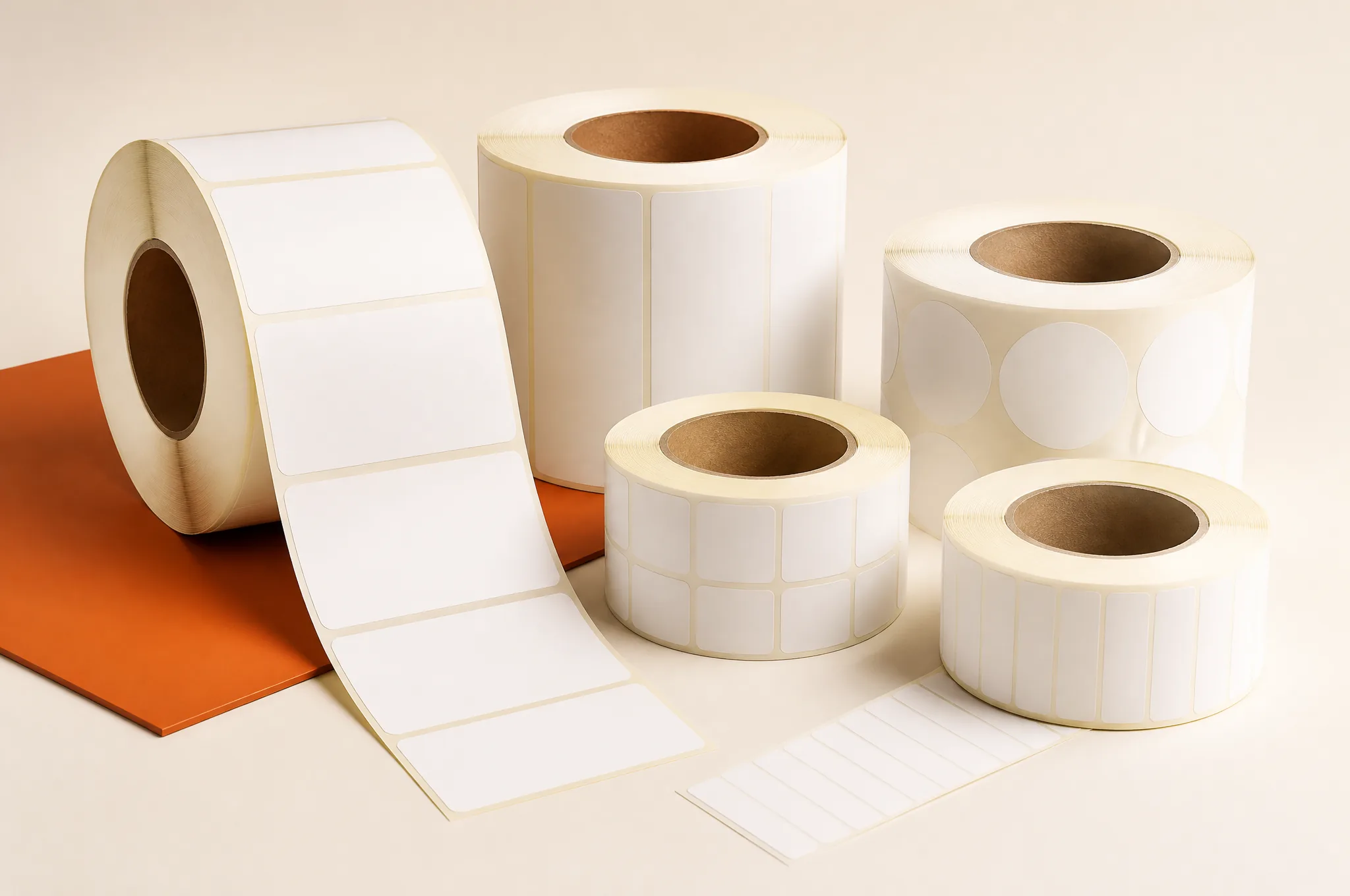
Select the thermal face for the required life
Direct thermal labels form an image in a heat-sensitive coating. A top-coated construction improves resistance to friction and moisture, while shorter-life retail work may use a simpler face stock.
Define how long the label must remain readable and what heat, light and handling it will face.
Match adhesive to surface and temperature
Permanent and removable are starting categories, not complete specifications. Corrugated board, glass, shrink film, chilled packaging and rough recycled cartons present different bonding conditions.
Describe the application surface and application temperature, then test the proposed adhesive on that surface.
Control liner and die-cut geometry
The liner carries labels through printing and application. Die-cut size, gap, corner radius and matrix removal determine how smoothly the web feeds.
For shipping labels, confirm whether the nominal dimensions refer to the label only and record the total web width separately.
Set core, winding and pieces per roll
Core inner diameter and outside roll diameter must fit the printer or applicator. Winding decides how the label presents at the peel point.
Pieces per roll affect reload frequency and final diameter. Confirm rolls per carton and carton marks with the same care as the label construction.
Purchasing checklist
Points to confirm before quotation
- Required image life defined
- Surface and temperature described
- Adhesive tested on the real substrate
- Die-cut size and web width stated
- Core and winding matched
- Pieces per roll confirmed